
Carrie Wieteska, Senior Account Manager & Rachel Russell, Graphic Design Director
Your stakeholders are judging your communications before they’ve read a single word. You can have all the right messages, data and insights, but if people struggle to engage with the way they’re presented, much of their impact can be lost.
When clients approach us about stakeholder communications, they focus initially on the messaging: what needs to be said, what tone to strike and what results to highlight.
As a communications agency specialising in stakeholder engagement, developing that copy is a key part of our role. However, there’s another factor that can make or break how your message is received: design.
Whether it’s an annual report, ESG update, strategy document, presentation deck, internal newsletter or investor communication, design does far more than make content look good.
Well-designed stakeholder communications reinforce your organisation’s credibility, strengthen your brand and, crucially, shape how your information is understood and acted on.
And in a world where audiences are overloaded with content, that matters more than ever.
First impressions matter for stakeholder comms
We’re all guilty of making snap judgements: you open a document and, within seconds, you’ve made assumptions about the company behind it.
Is the material clear? Professional? Credible? Easy to follow? Or does it feel rushed and difficult to navigate?
Stakeholders shouldn’t have to work hard to understand your message. The more effort it takes to process information, the less likely people are to engage with it.
Common issues we see with stakeholder communications include:
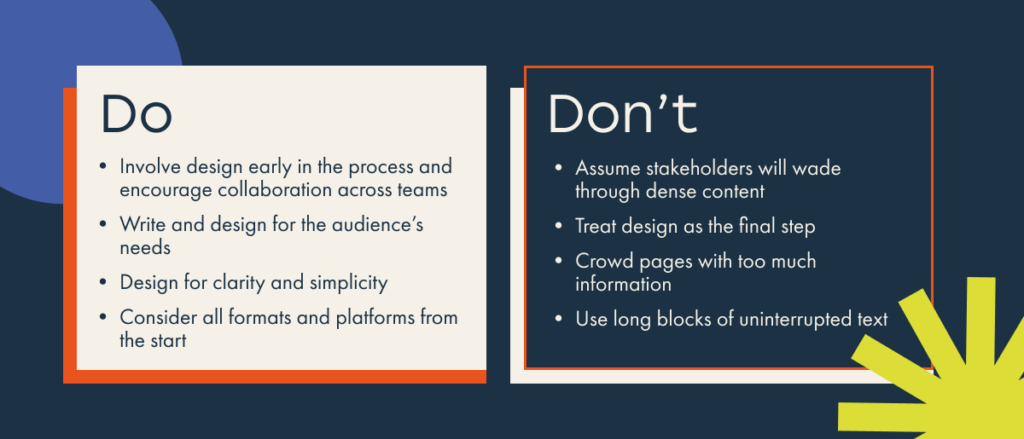
- Overcrowded pages
- Inconsistent branding
- Unreadable charts
- Poor accessibility
- Long blocks of uninterrupted text
- Information overload
Good design brings structure and clarity, making complex information easier for busy audiences to understand.
Good design simplifies your message
One of the biggest challenges organisations face is turning complicated information into something people can actually absorb.
Whether you’re producing your annual report or creating a thought leadership e-book, effective stakeholder communications start with audience needs.
Before producing a piece of stakeholder communications, ask yourself:
- What information matters most?
- What questions are they likely to have?
- How can we make this easier to understand?
- What action are we trying to drive?
Design should support these objectives. Clear layouts, thoughtful structure, strong visual hierarchy and well-designed charts all help audiences process information quickly and confidently.
Instead of overwhelming readers with detail, good design helps focus attention on what matters most. Increasingly, audiences expect that level of clarity as standard.
Expectations have changed
The bar for communications has changed massively over the last few years.
People consume content nonstop across multiple platforms, and their expectations for easy-to-consume material have risen accordingly. A static 60-page PDF packed with dense copy and tiny charts doesn’t hold attention the way it once did.
Modern stakeholder communications need to be clear and work across multiple formats, including:
- Digital-first annual reports
- Interactive presentations
- Mobile-friendly newsletters
- Social-ready assets
That doesn’t mean every report needs to be flashy or overly designed. In fact, the best communications are often the simplest.
The key is intention – design that’s part of the process from the beginning, not added on at the end.
Designing from the start
One of the most common mistakes we see organisations make is treating design as the final step in the process: the content is written, approved and shared with a designer with the directive to “make it look good.”
But the strongest stakeholder communications happen when strategists, writers and designers collaborate early in the process.
There’s more opportunity to think creatively about how information is structured. Messaging can be shaped with visual storytelling in mind, and design can reinforce strategic priorities rather than simply decorating content.
It also helps avoid one of the biggest pitfalls: forcing large amounts of information into formats that weren’t designed to carry it clearly.
The result is communication that’s not only informative but genuinely engaging.
Stakeholder communications are part of your marketing mix
As a leading communications agency, many clients initially approach us for support with media relations, social media or website development – but our work tends to extend much further.
Stakeholder communications are a core part of our client work, helping organisations build trust and engage with the audiences that matter most.
Every report, presentation, newsletter or update contributes to how your organisation is viewed. Their design influences first impressions and shapes understanding – and plays a huge role in whether stakeholders engage with your communications or simply skim past them.
If you’re investing in stakeholder engagement, design isn’t an optional extra. It’s a fundamental part of effective communication.
Whether it’s an annual report, presentation or internal communications project, thoughtful design can make the difference between information that’s ignored and communications that genuinely connect with people.
If you’re planning your next stakeholder communications project, contact us now to discuss how we can support with strategy, content and design.