

Carrie Wieteska, Senior Account Manager
Two years ago, adding “AI-powered” to a press release almost guaranteed media attention. Today, it can just as easily trigger scepticism.
For anyone working in B2B tech communications, the recent article in The Guardian exploring the rise of “AI-washing” struck a nerve; while AI remains one of the most transformative technologies in decades, the surrounding communications landscape is becoming progressively noisy.
As well as seeing this with our own eyes, we’re increasingly hearing it directly from journalists who are caught between genuine excitement about the emerging technology and fatigue from a constant stream of vague AI claims with little substance behind them.
AI is still hugely important and exciting. But with so many companies now claiming to use AI in some form, it’s becoming harder for genuinely innovative businesses to stand out from the crowd.
So, in an already congested media landscape, how can B2B tech brands talk about AI credibly without sounding like everyone else?
What is AI-washing?
AI-washing refers to the practice of exaggerating, overstating or loosely applying AI terminology to products, services or communications in order to appear more innovative or technologically advanced.
The term stems from “greenwashing”, which emerged in the 1980s to describe organisations presenting themselves as environmentally responsible while making little meaningful change in practice.
The Guardian article suggests the same pattern is now emerging around AI, as companies relabel existing automation or layer AI terminology onto messaging without materially changing the product itself.
The issue is not that businesses are talking about AI – many should be.
The problem is when the messaging becomes vague, exaggerated or disconnected from real-world outcomes.
Over time, this creates problems far beyond securing media coverage. It risks damaging credibility with everyone from customers and employees to analysts and investors.
This is particularly true in B2B technology, where audiences are far more aware of the difference between meaningful AI capability and surface-level positioning.
Why AI messaging is becoming a problem
As a B2B tech PR agency, we have a number of clients who are using AI to solve genuinely complex problems – and of course, we want to shout about it. But the key is genuinely having something meaningful to say.
The consumerisation of technology and the mainstream adoption of tools like ChatGPT mean journalists are becoming far more technically literate. It’s easier than ever for them to spot inflated messaging or vague positioning.
In speaking with industry veterans and tech journalists covering this space day in, day out, we’re hearing the same message repeatedly: AI alone is no longer a story. What matters is the problem being solved, the value being created and the proof behind the claims.
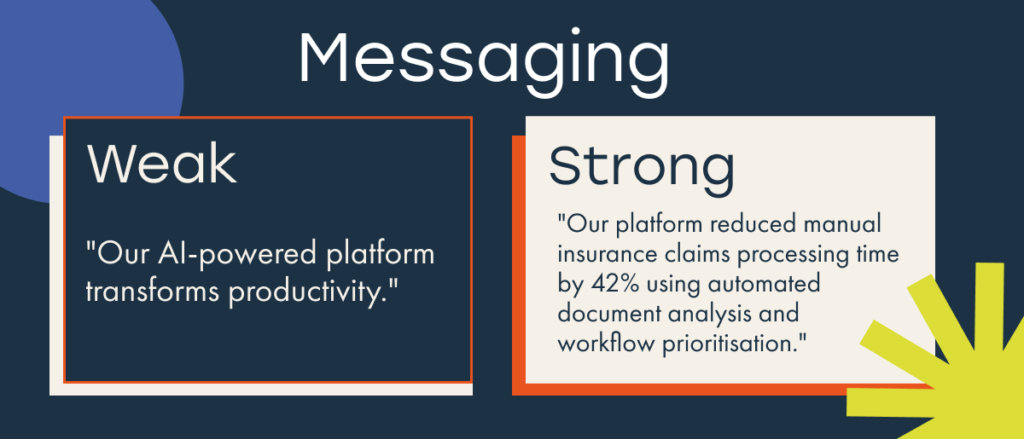
That means phrases like…
- intelligent automation
- revolutionary machine learning
- transformative generative AI
- AI-powered
…can quickly be undercut when they’re not backed up with specifics.
There is a significant difference between saying a platform is “AI-powered” and explaining how it reduced processing times, improved forecasting accuracy or automated a previously manual workflow (particularly if you can add stats to these statements): the latter gives journalists, customers and stakeholders something tangible to evaluate.
AI is rapidly moving from novelty to expectation. And that means the standard for communications has become much higher.
Not every tech story needs AI
One of the biggest mistakes technology companies – or any company, really – can make right now is trying to force AI into an announcement.
Sometimes the real story has nothing to do with AI. A powerful, and newsworthy, B2B press release can cover:
- commercial partnerships
- customer growth or market expansion
- regulatory insight
- security performance
- operational resilience
In all of these cases, adding unnecessary AI language can dilute your narrative. And even if technology is central to the story, it doesn’t need to be your headline.

The real story is about original perspectives, market insight and the human impact. Sure, if relevant, you can absolutely bolster it with useful data and an explanation of technology. But don’t focus on AI for AI’s sake.
The next phase of AI communications
AI is not disappearing from technology communications any time soon, but the way companies talk about it is changing. It’s no longer a novelty – and that’s an important consideration when crafting your messaging or developing a strategy.
Instead of relying on AI terminology to drive immediate coverage, build credibility in your press releases by focusing on:
- communicating clearly
- demonstrating genuine value
- resisting the temptation to overstate what the technology can do
Because when it comes to building your reputation, whether you’re targeting stakeholders, customers or journalists, credibility is one of the most valuable assets a technology company can have.
If your business is navigating how to communicate AI innovation without sounding like everyone else, get in touch with our team.