
From detail lovers and big-picture thinkers to list makers and those who would rather just get stuck in – no two people approach work in quite the same way.
As part of our focus on wellbeing in October, our Director of Technology, Annabel, reflects on why understanding those differences matters – and what a great workplace culture looks like when people feel comfortable being themselves.
From using Insights Discovery to learn more about what makes colleagues and clients tick, to creating the trust and openness that allows people to bring their quirks to work, Annabel explores how greater awareness of ourselves and each other can help us build stronger teams – and genuinely enjoy working together.
1. Workplace culture can sometimes feel like quite an abstract concept. What does great culture actually look and feel like to you?
One of my common refrains when interviewing new people is: “Bring us your quirks!” And I think that sums up what a great culture feels like to me.
It’s somewhere people feel comfortable being themselves – not just bringing the professional shell to work, but the person underneath. That means being vulnerable about when they need help; being able to articulate their behavioural preferences without fear of judgement; and feeling free to express the different parts of their personality.
And that does include the good and the bad. If you accept my freakish organisational and proofing skills, you also have to accept my occasional grump or pass-agg moment!
I love learning details about my colleagues’ lives – their niche hobbies, food icks, TV obsessions and more. Those things might seem small but knowing them builds a much deeper level of understanding and connection between people.
Ultimately, that shows up in how teams work together. When people truly understand each other, they’re able to navigate difficult moments with empathy and openness. But it also makes the everyday experience of work more enjoyable – because you’re not just working alongside colleagues, but people you genuinely know and connect with.
That sense of enjoyment is so critical. I used to joke with my former MD that, over the 14 years at the same company, we’d probably spent more time with each other than with partners, friends or family. And it’s true: those 9-5s really add up. If we’re going to spend that much of our daily lives together, trying to mask parts of yourself would just be exhausting.
2. We use the psychometric personally assessment tool Insights Discovery to help us understand different personalities and working styles. What first made you see value in that approach, and how has it changed the way we work together?
My first experience of Insights Discovery involved a workshop where we were asked to plan a party in our separate colour groups. I remember being fascinated by how each group approached the task – and how closely those approaches matched what we’d just learned about our profiles. My group immediately started a detailed list of all the information we’d need to collect. As I know only too well now, that was a very blue response – and quite a contrast to the other groups who started discussing personalised invites (hello team green) or fireworks (hello team yellow).
I’ve always been interested in understanding the ‘why’ of things – which is probably the blue in me again – and initially that’s where I saw the value of Insights. It was brilliant for self-awareness: helping me learn why I react to certain things in the way I do as well as where I can be most valuable to my teams and where my blind spots might be.
Over time, I’ve realised there are so many other layers of value to Insights. It helps you understand how and why other people react to things, and how you might adapt your own approach accordingly.
I also think it gives us a really useful, neutral language for talking about behaviours. It helps us translate the root cause of friction without having to use a negative term like ‘blunt’, ‘slow’ or ‘scatty’. That allows for a much more constructive conversation and often a far quicker resolution.
Another layer of value is at the team level. Insights provides a way for us to understand our collective dynamics and where we might have blind spots as a group. I think that becomes particularly interesting when you frame it against our clients’ colour preferences. It’s not just about understanding how we work with each other, but recognising where our collective preferences might be different from those of the people we’re working for – and again adjusting our delivery accordingly.
3. Understanding someone’s personality is one thing but adapting how you work with their ‘Insights colour’, is another. How have you seen this put into practice at Clark?
One of the main ways we’ve put this into practice is in how we communicate and brief each other. Knowing someone’s colour preference gives you a better sense of what they might need from you to do their best work – whether that’s more detail, more space to think, or concrete outcomes to target.
Our tech team is a good example. We have a lot of blue energy in the team, which makes sense given the complexity of the industry we work in. But it also means we tend to want detailed briefings and to understand the ‘why’ behind something before we’re comfortable acting on it. Knowing that helps others think about how they bring us into a project and what information they give us upfront. But we also have to be conscious of times where we need to push back against our blue tendencies – when quick action is needed despite sparse detail.
More broadly, our Insights awareness has influenced the types of meetings we run, how we frame asks, and even how we interpret and respond to interactions with each other. Perhaps most importantly, it’s encouraged us to ask more questions of each other rather than assume everyone operates like us.
4. We also take great care and effort into understanding how our clients like to work. How does adapting to their processes, personalities and behaviours help us build stronger relationships and achieve better outcomes?
Good PR teams act as an extension of a client’s in-house team, filling gaps in their existing capabilities and providing support in as seamless a way as possible.
A big part of achieving that is understanding not just what a client needs, but how they like to work. Recognising different personalities and colour energies allows us to adapt everything from the communication channels we use and the way we structure meetings, to the tone and level of detail in our emails.
That adaptability reduces friction and makes the relationship more efficient. Clients feel understood, communication becomes easier and decision-making can happen faster. Over time, that builds greater trust and a stronger working relationship.
5. What advice would you give for leaders who want to create a workplace where different personalities can thrive?
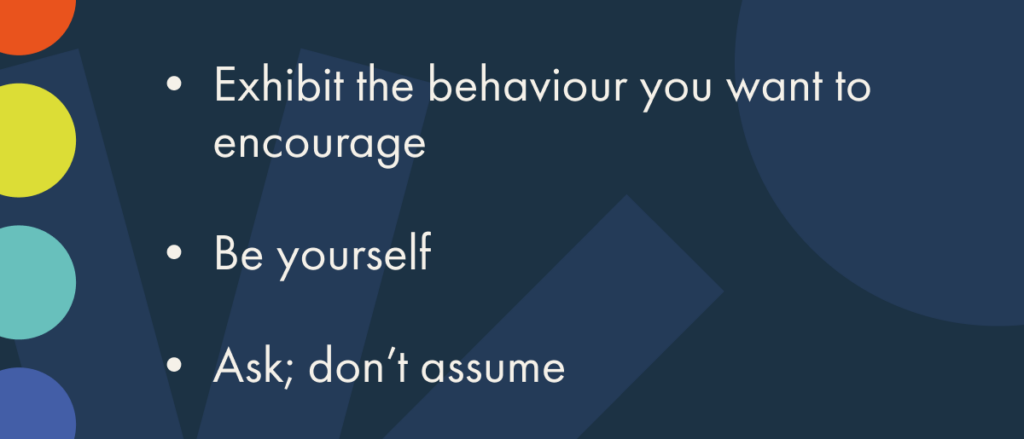
I think it starts with exhibiting the behaviour you want to encourage. If you want people to feel comfortable bringing more of themselves to work, you have to be willing to do the same.
There’s a reason I talk about my ‘old lady Zumba’ or share the slightly random details of my life. It signals that all parts of who we are are welcome at work. Leaders set the tone, and if you’re always presenting a polished professional version of yourself, it’s hard to expect others to do anything different.
Questions are also key to creating space for different personalities. Ask people what they prefer rather than assuming: how do they like to receive feedback? How much context do they need? Do they want time to think something through, or would they rather talk it out? And then, importantly, be willing to adjust your approach based on what they tell you.
6. Having led training at Clark on different working styles, what have you learned about your own?
For me, the value of understanding my working style isn’t just knowing what I’m good at; it’s recognising when I need to work against my natural preferences rather than lean into them.
I have a lot of blue energy, so I like detail, data and process. Those things are often strengths, but I’ve learned to recognise when ‘bad blue’ is taking over – like when I’m delaying a decision because I want to gather just one more piece of information, or relying too heavily on process because it feels comfortable.
It’s also reminded me that I need to keep pushing myself towards the next idea, rather than perfecting what already exists.