
Rachel Russell, Graphic Design Director
Picture the scene: a chaotic desk, a darkened room, an anguished cry from a hunched figure…
Nope, not the opening act of Frankenstein, just the everyday horror of a design job gone awry. I’m being a tad melodramatic, but why not? The Traitors is on TV and Halloween is around the corner.
Briefing a graphic designer can sometimes feel a bit daunting, particularly if design isn’t something you deal with every day. But armed with a little more information, you can get your project off to a good start and make sure the end result is exactly what you had in mind.
As Graphic Design Director at Clark, a Scottish PR agency with design at its heart, I know a thing or two about helping clients communicate clearly. So, here are my answers to nine common questions I often get asked about working with designers, along with some advice on how to avoid any nasty surprises in the process.
1. How do I write a graphic design brief?
When considering how to brief a graphic designer, start with what you’re trying to achieve rather than what you want the finished piece to look like.
Ask yourself:
- Who is it for?
- What are you trying to communicate?
- What do you want people to think, feel or do?
- Does it sit within an existing project, brand or campaign?
Then there are the practicalities:
- What format will the finished design take?
- Where will it be seen or used?
- What’s the budget?
- Is there a fixed deadline?
- Who needs to approve it?
Be clear and concise, but give your designer as much useful information as you can. After all, the better we understand what you need, the better the work we deliver.
And if you’re not sure what should be in the brief? Just ask. Helping to shape it is often part of the design process.
2. Do I need to know exactly what I want the design to look like?
Definitely not.
The joy of working with a designer is giving them a challenge and seeing them come back with a solution you might never have considered.
Examples of things you like (or don’t like) can be really useful, but try not to design the finished product before the designer has had a chance to think about it.
“I want our members to understand these key messages quickly” gives us a clear objective. “Put the messages in a big green box” has already decided how to meet it.
3. Beyond a good brief, what does a graphic designer need from me?
Starting a project with a comprehensive set of assets will always make things run more smoothly. Here’s my handy checklist:
- Logos and brand assets
- Brand guidelines
- Final (or as close to final as possible) content
- Photography and illustrations
- Examples of previous design work
- Technical specifications, if you have them
- Accessibility guidelines
- Deadline
- Budget
If one of these things isn’t ready, don’t panic. Just tell your designer. It’s much easier for us to plan around a missing set of photographs or copy that’s still being signed off if we know about it from the outset.
4. What’s the best way to give feedback to a graphic designer?
It can feel awkward telling a designer you’re not happy with their work, but if something isn’t working in a first draft, be clear about what it is and why.
You don’t necessarily need to suggest the solution. That’s the designer’s job.
Rather than “make the logo bigger”, for example, tell us “the branding needs more prominence”. That gives us room to consider the whole design and find the best way to solve the problem.
It also helps enormously to have one client contact who collates feedback from everyone involved. Five stakeholders sending five sets of sometimes contradictory comments is when things can start to get a little… spooky.
5. What’s your graphic design process?
At Clark, design is a collaborative process.
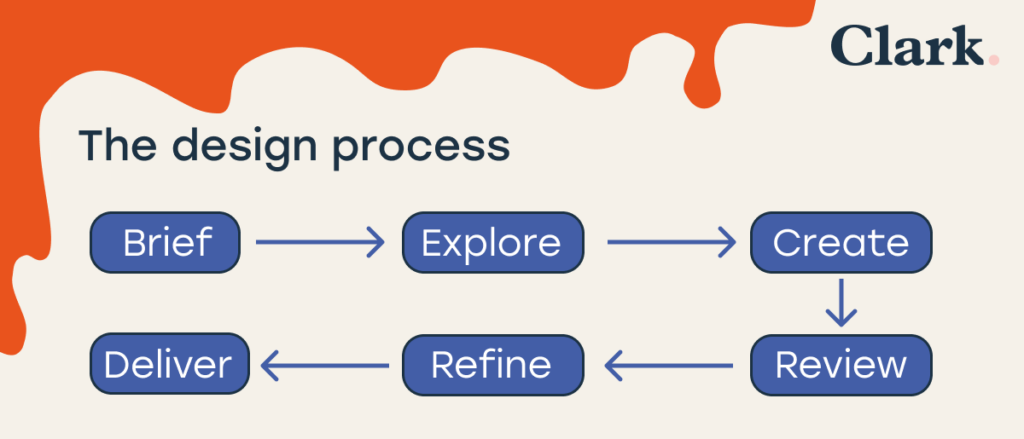
We’ll ask questions, explore ideas and develop a creative approach that responds to the brief. We’ll share our thinking, gather your feedback and refine the design through agreed rounds of amends before preparing everything for its final destination – whether that’s print, digital or both.
The exact steps will vary depending on whether we’re creating a brand, annual report, campaign, website or something completely different, but clear communication runs throughout.
No disappearing into a darkened room for three weeks and emerging dramatically with a finished design.
6. How long does graphic design take?
The slightly frustrating answer is: it depends.
A social media graphic might take a matter of hours. A report or campaign assets could take several weeks or even months.
Complexity isn’t the only factor. Timings can also depend on how much content there is, whether photography or illustration is required, how many people need to approve the work, accessibility requirements, print lead times and the number of rounds of amends planned.
This is why deadlines are an important part of the initial brief. Tell your designer when you actually need the finished product – particularly if there’s an immovable launch, event or publication date involved.
We can then work backwards and build in sensible time for concepts, feedback, amends, artwork and production.
7. What exactly will I receive from my designer?
This is definitely essential to agree before the project begins.
For a print project, you might receive the finished printed materials, a print-ready PDF or both. For digital work, it could be optimised PDFs, JPGs, PNGs, SVGs or files prepared to specific dimensions and platforms.
A campaign with multiple outputs might involve a whole suite of assets.
There’s no need to understand every file format before you brief a designer. Just tell us what you ultimately need to be able to do with the finished work and we can advise on the best way to deliver it.
8. How much should I budget for graphic design services?
Never be afraid to have a conversation about money.
At Clark, we don’t start work on a new project without an agreed budget estimate in place. That means our clients know exactly what they’re committing to.
This is also where a clear brief really earns its keep. The more we understand about the scope of the project, the more accurately we can estimate the time involved.
Remember, the design fee might not be the only cost. Depending on the project, your budget may also need to cover things like printing, photography, illustration, stock imagery, web development or delivery.
If you have a fixed budget, tell us. A good designer can often suggest the best way to use it rather than simply telling you what you can’t have.
9. What happens if my brief changes?
It’s never ideal when a brief alters halfway through a project, but it happens. Projects evolve, stakeholders shift their priorities and occasionally something comes completely out of left field.
The best way to handle it is to have a conversation with your designer as soon as you realise you’ve started to drift from the original brief.
The problems tend to start when a project quietly grows rather than being rebriefed: one extra page becomes ten, one format becomes six, or a “tiny tweak” means reconsidering an entire concept.
A change in scope may affect the budget or deadline, but that doesn’t mean it has to derail the project. Flag it, talk it through and agree the best way forward.
After all, nobody likes a jump scare.
Design doesn’t have to be scary
Most design horror stories don’t come from a bad client or a difficult designer. They come from a lack of communication, unclear expectations or false assumptions being made on both sides.
A good designer should ask questions, challenge you occasionally and help you work out the best way to communicate what you need to say. And a good brief gives them the information and space to do that.
So don’t worry about knowing all the design terminology or arriving with a fully formed output in mind. Tell us what you’re trying to achieve, give us the information you have and talk to us. We’ll take it from there.
Got a design project lurking in the shadows? Get in touch with the Clark team and we’ll help you confront it.